If this is your first visit, be sure to
check out the FAQ by clicking the
link above. You may have to register
before you can post: click the register link above to proceed. To start viewing messages,
select the forum that you want to visit from the selection below.
The Early Years
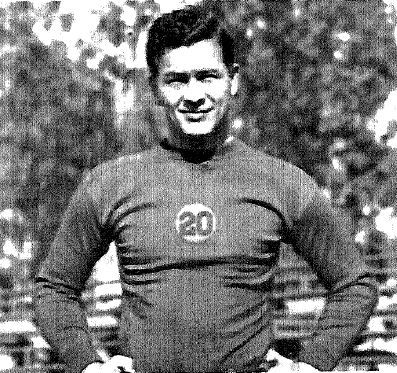
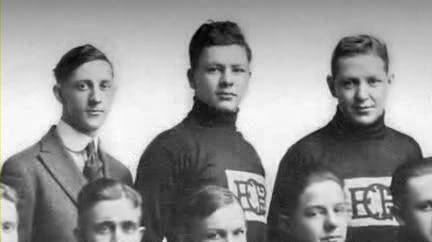
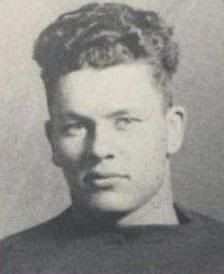
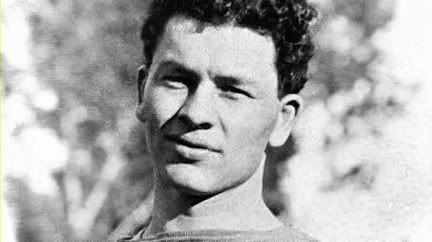
Curly was an athletic phenom at East High School, strong and agile, a multi-sport athlete, captain of the football team as a senior, who was a cock-sure kid and very much a ladies’ man.
Lee Remmel has said that he believes it was Curly’s pompous air and panache that gave us the Green Bay Packers and why Green Bay still has the Packers. There were an awful lot of guys who played by the rules and didn’t break some of those social norms, and their teams of course no longer exist.
Not only was he fast and athletic, he was strong. As a high school senior in the local conference track meet, he won the shot put, discus, and hammer throw.
He was considered a triple threat on the gridiron, because he great runner, passer, and could drop-kick very well for field goals and extra points, which were a bigger part of the game in that day.
Lambeau actually coached the East football team his senior year under the supervision of a teacher who had been assigned to take charge of the team, but knew nothing about the game.
Notre Dame
Lambeau played for legendary coach Knute Rockne at Notre Dame in 1918, making the Irish's varsity squad and lettering as a freshman, but a severe case of tonsillitis forced him to return home before his sophomore year.
History Re-Written
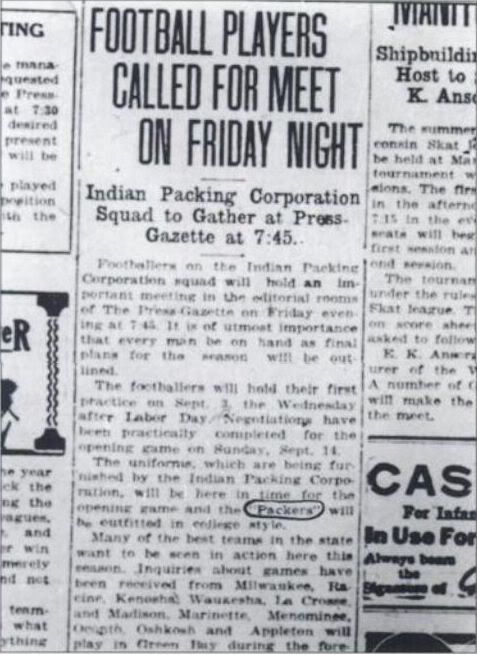
Packer history tends to begin in 1919 when, as the story goes, Lambeau told George Calhoun, the sports editor of the Green Bay Press Gazette, that he wanted to start up a football team. Then, Calhoun placed an article in the paper to recruit some players and the Packers were born.
This is wrong, or at the very least, isn’t the whole truth.
Calhoun did put an article in the paper, but this had been done for years to round up the town team players and begin the season. The players had already been confirmed as a matter of course from last year’s squad.
His girlfriend at the time, who would become his first wife, Margerite (Van Kissel) Lambeau, provided another glimpse of the truth.
“Marcel (Lambeau's father) wanted Curly to return to Notre Dame that fall, but he didn't want to go. He hated school, and he had a good job with the Indian Packing Corporation. Even so, if he wanted to play football, he had to go back to Notre Dame. Or so he thought until Calhoun suggested that he could play for the town team. That sealed the deal. Lambeau stayed, and he was elected as the team captain, a title that meant he was in charge of the team on the field.”
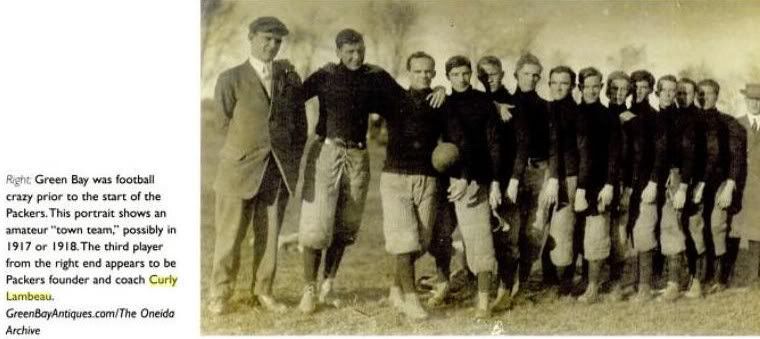
In fact, Lambeau had illegally (according to high school rules) played for the town team prior to 1919 while he was still in high school, or after the high school season, in 1917.
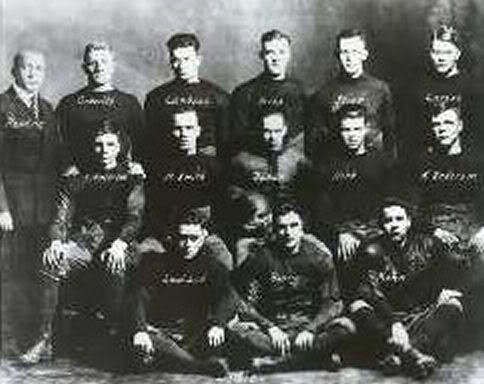
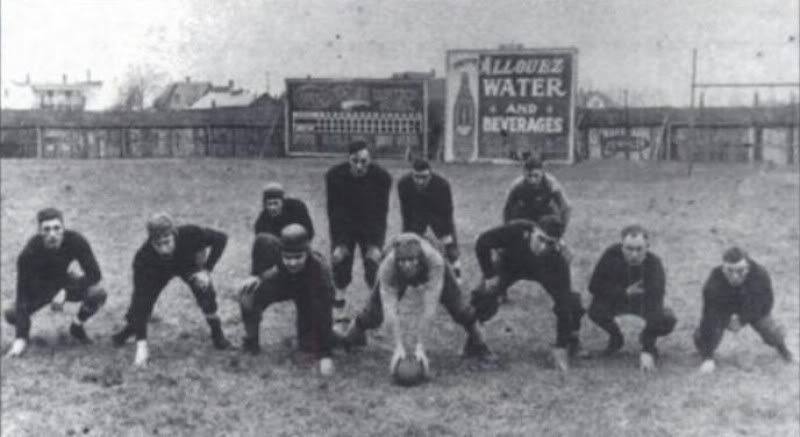
Lambeau is in the right half-back position (in the back left) of this 1917 Green Bay town team photo.
Most of the players that played in 1919 had also played for the town team (including Lambeau) in years past. The only difference in 1919 was that Lambeau, coming off the huge (and warranted) lift he had in his football status as starting back for Notre Dame, was elected captain, and this was the first year that the team was called the Packers, as Lambeau did in fact get $500 from his employer (the Indian Packing Company) for uniforms and equipment in exchange for the publicity that would come with the team being named after the company.
Otherwise, the Packers team in 1919 was a seamless continuation from previous years' teams.
On the Field
Lambeau played for the Packers until 1929, when he ended his playing career and only coached the team.
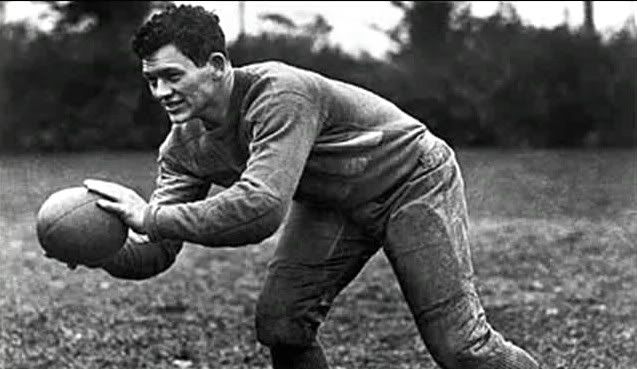
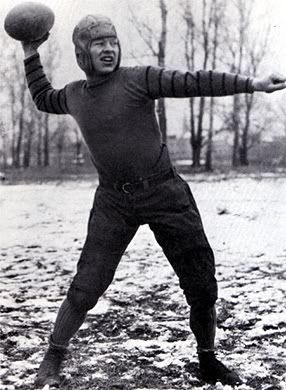
Although Lambeau played halfback, he was the player who took the snap from the center, as was common practice during that period.
From the beginning, Lambeau was one of the most important innovators in the history of the game of football.
He decided that running the ball on every play wasn’t good enough, that passing the ball with regularity would bring greater success.
But he also took passing to another level in terms of game-planning. He determined that passing routes could be more effective when planned out, so he decided to have the receivers run specific routes.
Opposing teams hated this, as the Packers became highly effective at it. They would say that passing was for sissies.
When the Packers played a passing game against a team of miners in Michigan's Upper Peninsula, Lambeau "had to run for his life," according to Jim Doherty in Smithsonian. Lambeau later remarked, "Those miners were tough."
Not surprisingly, Lambeau threw the Packers' first official pass, first official touchdown pass, and kicked the Packers' first official field goal.
played for legendary coach Knute Rockne at Notre Dame in 1918, making the Irish's varsity squad and lettering as a freshman, but a severe case of tonsillitis forced him to return home before his sophomore year.
Sorry for this, but, please Rats:Educamate me!
What is a VARSITY?
What does it mean to "Earn a LETTER?
Google give me no clues and I keep reading this stuff. I'd like to understand.
/Thread Jack.
This is a sensational thread. I'm learning so much!
In high school predominantly today, but also in colleges, schools often have a "varsity" team as well as a "junior varsity" team. The best players play "varsity" while the younger players typically would play on the "junior varsity" team. It would have been uncommon for a first year college player in that day to be good enough (or mature enough) to play for the varsity team, which was comprised predominantly of the upper-classmen.
To earn a "letter" which would be placed on a jacket for display, players have to have played in games on the varsity team a certain amount, such as a starting player would earn.
Here's an example of a letterman's jacket Tar, that you don't see much anymore, but used to be very popular with high school and college athletes. Athletes would earn their "letters" and badges by virtue of their athletic performance and display them on their jackets.
In Oz, we have a team for each age. No matter what grade we are in, we play all our sports at our own age group. No matter how talented.
We also two teams from Grade 3 to Grade 6. Junioers and Seniors. But in High School, from Grade 7 to grade 12, we have a team per Grade/Age.
We don't have the cool looking jackets, no symbols of "belonging".
The worst thing is, we don't have cheerleaders!!
Now, I'm talking about Sydney in the 70's. Quite possibly, things have changed. Also worth pointing out: I was the captain of my cricket team and rugby League team and it made zero impression on the ladies.
In case anyone is questioning the football voracity and talents of Manboobs Buck, here's an article that shows he was indeed the man back in his day...
Originally posted by Dennis Gullickson and Carl Hanson in "Before They Were the Packers
On October 17, 1896, a former University of Wisconsin-Madison footballer named T.P. Silverwood was introduced.
Silverwood graduated with a law degree and came to Green Bay on a bicycle looking for a career as an attorney. He subsequently entered into the firm of Ellis and Merrill.
His law career would include a stint as Green Bay district attorney in 1904 and several high profile cases including a Neillsville, WI murder. However, football was not far from his mind and was likely the reason he traveled to Green Bay.
At the end of the 1896 season, the Green Bay Advocate interviewed Silverwood on “football benefits.” They identified him as a “ball enthusiast,” the interview focused on the brutality of the game and its effect on high school and college students.
Silverwood turned the interview toward the rewards of training and discipline required for football success. When asked, “Is it a brutal game?” Silverwood’s response was definite:
No! It is no more brutal to the player than the race to the trotting horse. To be sure, there are scratches and bumps and bruises, but these are nothing to one who’s been in the glorious hand-to-hand struggle of a football game, where all the physical strength, all the brains and all the science of one team are pitted against that of another team.
In the mass of bodies in the trenches Hulbert, and now Tom Silverwood, saw the kinetic pulse of strategy and finesse and a game elevated by their use.
In 1897, all the pieces seemed to be in place; superior talent, tremendous organization, great coaching, fan support, great press coverage and strong financial backing.
The Green Bay newspapers covered several team meetings in late August and early September, some coinciding with team practice.
The team met regularly at the headquarters of the West Side Athletic Association where Hulbert worked.
To accommodate the players with day jobs, arc lights were strung around the field at Ben Garlock’s lot on the corner of Dousman and Oakland for night practice.
By now the team had added a “second eleven” which would “meet every evening with the regular eleven for practice.” They had every reason to envision success. They were big, they were buff, and they were ready.
Hulbert’s presence was the key to the team in 1895, and the addition of Silverwood near the end of 1896 was also significant.
But the enlistment of Tom Skenandore, a bruising fullback from Oneida, who had acquired his football skills on teams at Carlisle Indian School in the early 1890’s was the key piece of the puzzle in 1897. His value was such that he became the first (and only in 1897) paid player on the team.
Silverwood assumed position as captain and coach of the team in 1897, and he immediately implemented some ideas about how to improve the team – both on and off the field. A board of directors was formed to ensure community support, and a second team was added to give the regulars real practice. In 1896, Hulbert, nicknamed, “Genial Fred” was willing to step back and let another hand lead the flock.
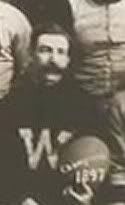
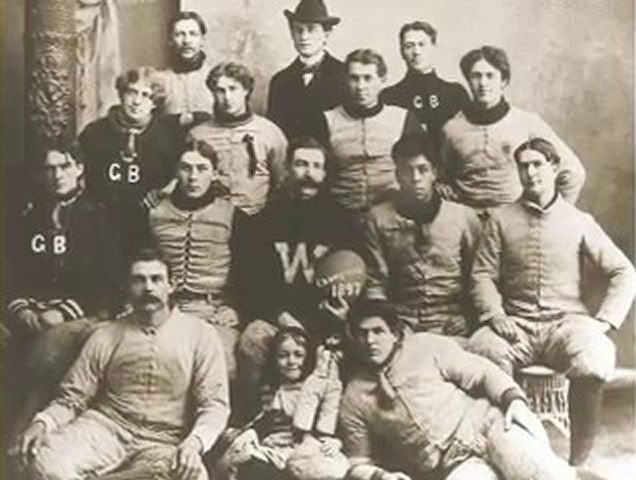
Tom Silverwood was a staunch believer in athletics, a gifted organizer, a colorful character with a handlebar mustache, a Republican activist and a lover of football.
Most of all, he had connections. Family documentation states that, “In 1897, Silverwood organized, coached and captained the Green Bay professional football team. The squad, predecessor to the present Green Bay Packers, played both professional and college teams and was undefeated for two years.”
With the presence of the first paid player in Green Bay history, Tom Skenadore, Silverwood’s squad did constitute the city’s first “professional” aggregation. The team passed a hat throughout the crowd of spectators for contributions, which were used for medical bills and to provide a stipend for some of the players depending on how much money they had at the end of the year. The amount was never enough to support a man and his family.
Out of five games in ’97, Silverwood’s squad went 4-0-1. The 1898 campaign was brief, but it was also without a loss.
It was Silverwood’s friendship with Kewaunee native Ikey Karel, who’d been tagged as “the Red Grange of the ‘90’s” that brought Karel to Green Bay as part-time coach and supporter of Green Bay football. It was Karel who, while watching the team practice on Garlock’s vacant lot, stated, “Some day Green Bay will be world champions.”
Under Hulbert and Silverwood, the team had advanced from a crew of undersized street brawlers to a crack unit with a statewide reputation.
The final game of the 1897 season, against Fond du Lac was played at Washington Park on Thanksgiving Day in a snow storm. An amazing 1,000 spectators looked on while the visiting team was dominated by a score of 62-0. “Fond du Lac wasn’t in the game one minute,” stated The Green Bay Review. “The visiting eleven was out-classed, out-played and outed generally.”
In 1919, Curly Lambeau’s pass-oriented juggernaut overwhelmed its opponents by a total combined score over 11 games of 565-12, for an average of 57-1 per game. But 23 years earlier, the Green Bay town team had accomplished a similarly remarkable feat. 1897 was part of an era when the emphasis was on defense and preventing the other team from scoring. Touchdowns were worth only four points. Yet, over five games, the Green Bay boys had bested their opponents 142-6 for an average of 28-1 per game.
This 1897 outfit was the very first championship football team in Green Bay history. It declared its status as such at the end of its amazing season, and no challengers issued a defi to say it otherwise.
Curly Lambeau’s team won its first National Football League crown in 1929, followed by championships in 1930 and 1931 – the first triple championship in NFL history. But the 1929 crown was not Green Bay’s first. Titletown saw championships in 1903, 1911, 1913, and 1915 as well.
The team photo taken at the end of 1897 is the first known picture of a Green Bay town team.
Going into 1898, thanks in large part to the efforts of Silverwood, the team had reputation, organization and financial success.
Great work Vince. Did you raid Lee Remmel's basemnet?
Do you have a good picture of Buckets Goldenberg? There is a great picture of him in the book.
After lunch the players lounged about the hotel patio watching the surf fling white plumes high against the darkening sky. Clouds were piling up in the west… Vince Lombardi frowned.
After lunch the players lounged about the hotel patio watching the surf fling white plumes high against the darkening sky. Clouds were piling up in the west… Vince Lombardi frowned.
Do you have a good picture of Buckets Goldenberg? There is a great picture of him in the book.
That's the only one I have ever seen. I just archive the shit I run across. Over time it's added up. Packer history is probably the most interesting thing I like to read about in my downtime.
If you look at the photo of Green Bay's river front from 1922 in HowardRoark's link you'll see a tall white building that is still standing! I think it is on the corner of Walnut & Washington Street (but it might be Adams).
10 years ago when I still lived in GB I sang with a group of women called the Angels. We performed in nursing homes in the afternoon once a week. I'll never forget one afternoon at a GB nursing home one of the nurses there pointed out a beautiful but elderly lady in a wheel chair watching our little production. This woman was in her upper 90's but her face was as smooth as a 30 year old. That woman was Marguerite Lambeau! She had Alzheimer's so you couldn't really talk to her. But it would have been cool to pick her brain if she hadn't had dementia like that!
In Oz, we have a team for each age. No matter what grade we are in, we play all our sports at our own age group. No matter how talented.
We also two teams from Grade 3 to Grade 6. Junioers and Seniors. But in High School, from Grade 7 to grade 12, we have a team per Grade/Age.
We don't have the cool looking jackets, no symbols of "belonging".
The worst thing is, we don't have cheerleaders!!
Now, I'm talking about Sydney in the 70's. Quite possibly, things have changed. Also worth pointing out: I was the captain of my cricket team and rugby League team and it made zero impression on the ladies.
I've always wanted to play rugby. Too late for that now... I've also wanted to learn about cricket. That's for another forum I guess.
 Tweet
Tweet






Comment