Announcement

Collapse
No announcement yet.

Read This, Be Smarter: NFL Route Tree

Collapse
X
 
  • Filter
  • Time
  • Show
Clear All
new posts

  • Read This, Be Smarter: NFL Route Tree

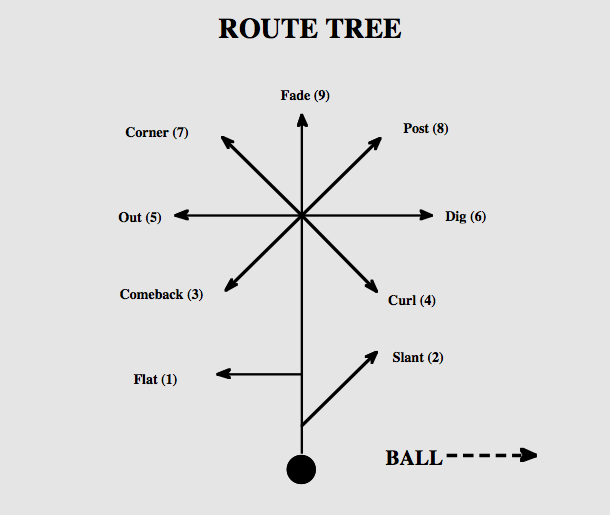
    Written piece that goes into detail about when you can run these routes and when you can't (wide split by WR can shave the tree almost in half) and how the DBs use this knowledge to compete.

    In today’s installment of the “NFL 101” series, former NFL defensive back Matt Bowen breaks down the basics of the route tree to give you a better understanding of the pro game.


    1. Flat
    2. Slant
    3. Comeback
    4. Curl
    5. Out
    6. Dig
    7. Corner
    8. Post
    9. Fade

    Bud Adams told me the franchise he admired the most was the Kansas City Chiefs. Then he asked for more hookers and blow.

  • #2
    with m3, you can forget about all those branches on the tree, he runs the "fade" on 90% of the plays, no matter if its 1st and 10, 3rd and 10, or 4th and 1

    m3's route tree is a pole

    Comment


    • #3
      MM runs the most varied of routes in his passing schemes, he runs 9's that you don't approve of, but he runs all kinds of sluggo's, double moves, shallow crosses etc.

      Sometimes, when you can hear a play call, you can figure out the route scheme. One of the most famous route schemes is called 525 F slant. 4 receivers, both wide guys run outs (5's). The TE runs a shallow slant (2), the flanker runs a delayed slant (F slant). This play was pioneered by Cowboy OC Ernie Zampese. Around the league, the 525 F slant is called "Zampese" by DC's.

      Matt Bowen is a great X's and O's guy and I really like this article. Maybe things have changed but I never knew of a 9 route being called a "fade". To me, a 9 is a go, a fly, a streak, straight up the field at the snap. A fade is a deep route, but angled to the sideline, it used to be called a flag pattern. The WR uses the sideline runs a deep route at that slight angle.

      A fly ain't a fade, but maybe things have changed over time.

      Wouldn't be the first time that something I know of now has a different name.

      Comment


      • #4
        Originally posted by KYPack View Post
        MM runs the most varied of routes in his passing schemes, he runs 9's that you don't approve of, but he runs all kinds of sluggo's, double moves, shallow crosses etc.

        Sometimes, when you can hear a play call, you can figure out the route scheme. One of the most famous route schemes is called 525 F slant. 4 receivers, both wide guys run outs (5's). The TE runs a shallow slant (2), the flanker runs a delayed slant (F slant). This play was pioneered by Cowboy OC Ernie Zampese. Around the league, the 525 F slant is called "Zampese" by DC's.

        Matt Bowen is a great X's and O's guy and I really like this article. Maybe things have changed but I never knew of a 9 route being called a "fade". To me, a 9 is a go, a fly, a streak, straight up the field at the snap. A fade is a deep route, but angled to the sideline, it used to be called a flag pattern. The WR uses the sideline runs a deep route at that slight angle.

        A fly ain't a fade, but maybe things have changed over time.

        Wouldn't be the first time that something I know of now has a different name.
        I think a couple have changed. A Dig used to be an In.
        Bud Adams told me the franchise he admired the most was the Kansas City Chiefs. Then he asked for more hookers and blow.

        Comment


        • #5
          Originally posted by KYPack View Post
          Matt Bowen is a great X's and O's guy and I really like this article. Maybe things have changed but I never knew of a 9 route being called a "fade". To me, a 9 is a go, a fly, a streak, straight up the field at the snap. A fade is a deep route, but angled to the sideline, it used to be called a flag pattern. The WR uses the sideline runs a deep route at that slight angle.

          A fly ain't a fade, but maybe things have changed over time.
          I was about to post almost identical comments, but you beat me to it. The terminology I grew up was different, but this is fascinating. I like Bowen. I've always known the 9 as a streak, a fade is angled, a flag is a post on this chart, a post is a corner on this chart, the flat was called a drag. The term corner was never really used. I always knew it more as a deep slant (as opposed to a shallow slant). Also, the curl or comeback was based on the way the route was run (comeback being a sharp, straight comeback where you are trying to drive the opponent back and then coming back sharply to create space; the curl more rounded). And the chart doesn't have an out and up--which was always the best route for me to run in those college intramural games back in the day.
          "There's a lot of interest in the draft. It's great. But quite frankly, most of the people that are commenting on it don't know anything about what they are talking about."--Ted Thompson

          Comment


          • #6
            Flag and corner might be interchangeable, schools used to use flags where there are pylons now, so flag IS the front or back corner of the end zone.

            But post is named for running at, or scraping a defender into the goal post when it was in the middle of the end zone (I am not old enough to have played then). Always the middle of the field. His chart has an indicator on the bottom to show you where the center/QB/ball is.
            Bud Adams told me the franchise he admired the most was the Kansas City Chiefs. Then he asked for more hookers and blow.

            Comment


            • #7
              Originally posted by HarveyWallbangers View Post
              I was about to post almost identical comments, but you beat me to it. The terminology I grew up was different, but this is fascinating. I like Bowen. I've always known the 9 as a streak, a fade is angled, a flag is a post on this chart, a post is a corner on this chart, the flat was called a drag. The term corner was never really used. I always knew it more as a deep slant (as opposed to a shallow slant). Also, the curl or comeback was based on the way the route was run (comeback being a sharp, straight comeback where you are trying to drive the opponent back and then coming back sharply to create space; the curl more rounded). And the chart doesn't have an out and up--which was always the best route for me to run in those college intramural games back in the day.
              We're gettin' old, Harv. & I've got a head start on ya.

              Yeah, I've never heard a fade called a go route, either.

              Specialty routes aren't in a tree. So double moves like a slant and go (Sluggo) are called in the play call separately.

              The fade I knew and learned ain't what they show in this article. I even looked it up in Wiki. (Now don't anybody post about how fucked up Wiki is!)

              Quote on

              The pass is used frequently in the West Coast offensive scheme, where quick, accurate throwing is key.[2] The pass may also be used closer to the goal line in what is called a "fade". The quarterback will lob the ball over a beaten defender to a wide receiver at the back corner of the end zone.

              Quote off

              Comment


              • #8
                Interesting Info, but there's a lot more to it than that - at what point in the route the QB hits the receiver, different windows if it's against a zone, breaking off routes, sitting down in a window of a zone, the way routes of different receivers affect others - picks, clearing out, etc. Some of that is subtle communication between an experienced QB and receivers he knows, but a lot of it is pre-planned, and from what I've seen, the Packers do a pretty sophisticated job of changing things up.
                What could be more GOOD and NORMAL and AMERICAN than Packer Football?

                Comment


                • #9
                  Originally posted by texaspackerbacker View Post
                  Interesting Info, but there's a lot more to it than that - at what point in the route the QB hits the receiver, different windows if it's against a zone, breaking off routes, sitting down in a window of a zone, the way routes of different receivers affect others - picks, clearing out, etc. Some of that is subtle communication between an experienced QB and receivers he knows, but a lot of it is pre-planned, and from what I've seen, the Packers do a pretty sophisticated job of changing things up.
                  This wouldn't be the original jso forum posting I need a big audience texaspackerbacker would it?

                  Comment


                  • #10
                    Which route a receiver runs is predicated upon the defense and what play call is on.

                    The receiver and QB have to be on the same page, or you end up with those embarrassing picks where the DB is just standing there waiting on the ball and there isn't a receiver in sight. Maybe the QB is wrong, maybe the WR is wrong - but one thing is for sure, one of them was wrong... usually it's the WR, i.e. he should have zigged instead of zagged.

                    Film study by the DB's can put them in position to make picks. If an offense is in 4 wides, and you know that against your presnap defensive look the slot receiver will run x route in combination with the outside receiver - and you also know that the adjustment to the coverage you switch to is a dig route and a 15 yd out... you can sit on those routes.

                    It all comes down to film study.

                    McCarthy is as good as there is in the league at designing an offense and attacking a defense - give him all the credit in the world for knowing his stuff on that side of the ball.
                    wist

                    Comment


                    • #11
                      Originally posted by Rastak View Post
                      This wouldn't be the original jso forum posting I need a big audience texaspackerbacker would it?
                      I think so--unless somebody decided to steal his identity.
                      "There's a lot of interest in the draft. It's great. But quite frankly, most of the people that are commenting on it don't know anything about what they are talking about."--Ted Thompson

                      Comment


                      • #12
                        Originally posted by KYPack View Post
                        MM runs the most varied of routes in his passing schemes, he runs 9's that you don't approve of, but he runs all kinds of sluggo's, double moves, shallow crosses etc.

                        Sometimes, when you can hear a play call, you can figure out the route scheme. One of the most famous route schemes is called 525 F slant. 4 receivers, both wide guys run outs (5's). The TE runs a shallow slant (2), the flanker runs a delayed slant (F slant). This play was pioneered by Cowboy OC Ernie Zampese. Around the league, the 525 F slant is called "Zampese" by DC's.

                        Matt Bowen is a great X's and O's guy and I really like this article. Maybe things have changed but I never knew of a 9 route being called a "fade". To me, a 9 is a go, a fly, a streak, straight up the field at the snap. A fade is a deep route, but angled to the sideline, it used to be called a flag pattern. The WR uses the sideline runs a deep route at that slight angle.

                        A fly ain't a fade, but maybe things have changed over time.

                        Wouldn't be the first time that something I know of now has a different name.
                        Yea, you (we) are old. I remember things mostly the way you do, as well as the In route Pb refers to.
                        The only time success comes before work is in the dictionary -- Vince Lombardi

                        Comment


                        • #13
                          Originally posted by KYPack View Post
                          We're gettin' old, Harv. & I've got a head start on ya.

                          Yeah, I've never heard a fade called a go route, either.

                          Specialty routes aren't in a tree. So double moves like a slant and go (Sluggo) are called in the play call separately.

                          The fade I knew and learned ain't what they show in this article. I even looked it up in Wiki. (Now don't anybody post about how fucked up Wiki is!)

                          Quote on

                          The pass is used frequently in the West Coast offensive scheme, where quick, accurate throwing is key.[2] The pass may also be used closer to the goal line in what is called a "fade". The quarterback will lob the ball over a beaten defender to a wide receiver at the back corner of the end zone.

                          Quote off
                          I always learned the fade to be a drifting flag route, where, like the endzone, the receiver runs straight, and as soon as he gets a step begins "fading" to the pylon so the QB can drop it to the sideline avoiding any safety help. We always called it a fade on either side since you were fading to the sideline.
                          The only time success comes before work is in the dictionary -- Vince Lombardi

                          Comment


                          • #14
                            Originally posted by wist43 View Post

                            The receiver and QB have to be on the same page, or you end up with those embarrassing picks where the DB is just standing there waiting on the ball and there isn't a receiver in sight. Maybe the QB is wrong, maybe the WR is wrong - but one thing is for sure, one of them was wrong... usually it's the WR, i.e. he should have zigged instead of zagged.
                            .
                            If you ask some people its the receivers fault about 334 out of 336 times.
                            The only time success comes before work is in the dictionary -- Vince Lombardi

                            Comment


                            • #15
                              Originally posted by KYPack View Post
                              We're gettin' old, Harv. & I've got a head start on ya.

                              Yeah, I've never heard a fade called a go route, either.

                              Specialty routes aren't in a tree. So double moves like a slant and go (Sluggo) are called in the play call separately.

                              The fade I knew and learned ain't what they show in this article. I even looked it up in Wiki. (Now don't anybody post about how fucked up Wiki is!)

                              Quote on

                              The pass is used frequently in the West Coast offensive scheme, where quick, accurate throwing is key.[2] The pass may also be used closer to the goal line in what is called a "fade". The quarterback will lob the ball over a beaten defender to a wide receiver at the back corner of the end zone.

                              Quote off
                              Am I the only one old enough to remember when the "comeback" was called a "button hook"?
                              Am I the only one old enough to even know what a real "button hook" is?

                              Comment

                              Working...
                              X