
 Tweet
Tweet
not bad, just left off virginny. CT's status as ocean state is still hotly contested.
-
-
Well, I got #1 and #2.
I got #3 except (1) I wasn't sure about New Hampshire (it does have coastline) and (2) I completely forgot the state of Virginia. I knew I was missing something in that area.
I don't buy the assertion that Connecticut is not on the coast of the Atlantic Ocean. Using the same logic, neither is Rhode Island. Rhode Island is bordered by the Block Island Sound and the Rhode Island Sound.
See this site for details. It's a great geography site, IMO.
Comment
-
I got the first two. Then I read the third and moved on.Originally posted by 3irty1Comment
-
Long Island Sound is an estuary, making its substance complete different from an ocean.Originally posted by the_idle_threat
Block Island and Rhode Island sounds are geographically straits, which is still the same substance as an ocean, only the geography of the area surrounding the body of water is different."I've got one word for you- Dallas, Texas, Super Bowl"- Jermichael FinleyComment
-
In that case, part of CT is on the ocean (Block Island) and we have to invalidate your perfect score and take back your prizes.
but thank you for playing.Comment
-
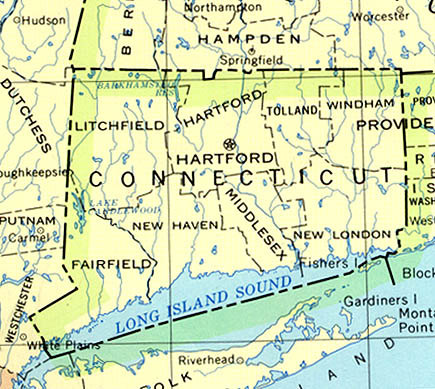
My map says otherwise."I've got one word for you- Dallas, Texas, Super Bowl"- Jermichael FinleyComment
-
Also, this link shows otherwise.
lient=firefox-a&rls=org.mozilla:en-US fficial&ndsp=20&ie=UTF-8&sa=N&tab=il
"I've got one word for you- Dallas, Texas, Super Bowl"- Jermichael Finley
fficial&ndsp=20&ie=UTF-8&sa=N&tab=il
"I've got one word for you- Dallas, Texas, Super Bowl"- Jermichael FinleyComment
-
Are you arguing with the judges?
Wikipedia considers LIS to be the pink area. I can almost see the people surfing in north CT.

Comment
-
The "estuary" argument doesn't hold water.Originally posted by BallHawk
There are estuaries that are part of the ocean. For one thing, how about Upper New York Bay (and Lower for that matter)? Both are clearly estuaries between the Hudson River and the Atlantic Ocean. Yet they are bays, which are by definition parts of a larger body of water. They are part of the Atlantic Ocean, just like Long Island Sound is part of the Atlantic Ocean.
And for that matter, as big as Long Island Sound is compared to the little rivers that trickle into it, I wouldn't consider the entire sound an estuary.Comment
-
Where does the Gulf of Mexico become the Atlantic Ocean? Where does the Atlantic Ocean become the PAcific Ocean around South America? I suppose answer is they gradually merge over a large area.
I don't think as estuary is part of the ocean, the water chemistry is different. Don't know if Long Island Sound is different enough from the Atlantic Ocean to be considered a seperate body of water.Comment
-
Long Island Sound is an estuary. An estuary is a tidal body of water that is fed by both salt and fresh water sources. Estuaries are partially sheltered water sources that are protected by land from harsh winds, and storms, that occur in oceans. Because of this protection, estuaries are perfect habitats for marine creatures in early stages of development .... Estuaries are important because they are among the most productive systems on earth. Due to the unique water chemistry, many habitats are created. The mixture of salt and fresh water, tidal conditions, and shelter from harsh atmospheric conditions, create a unique and critical habitat for the survival of many marine species. ... Long Island Sound’s salt-water source is the Atlantic Ocean; its fresh water is from all of the rivers that drain to it, but the most significant fresh water sources are the Housatonic, Connecticut, and Thames Rivers.Comment
-
So Ballhawk is correct, Long Island Sound is distinct from the Atlantic Ocean.
Only problem is it doesn't extend across all of CT, so he still loses all of his valuable prizes. Too bad - whop whop whop whop.Comment
-
-It's my understanding that oceans are defined geographically, not by water chemistry. Yes, there is the broad saltwater/freshwater dichotomy, but that is a general rule. Oceans have vast differences in water chemistry depending upon geographic factors such as depth, temperature, presence of active volcanoes, etc. The same body of water can have a different chemical makeup at different depths.Originally posted by Harlan Huckleby
-Some estuaries are clearly part of the ocean. Estuaries are defined as areas where freshwater sources mix with saltwater bodies of water. Look at where the Amazon, Congo or Gambia Rivers meet the Atlantic Ocean. There have to be estuaries between these rivers and the ocean, but the rivers empty directly into the ocean. The estuaries are the part of the ocean near the mouth of the river where the two kinds of water mix.
Ergo, if an area is an estuary, that does not make it a separate body of water distinct from the ocean.Comment
-
from Merriam Webster dictionary:
estuary
Main Entry: es·tu·ary
Pronunciation: \ˈes-chə-ˌwer-ē, ˈesh-\
Function: noun
Inflected Form(s): plural es·tu·ar·ies
Etymology: Latin aestuarium, from aestus boiling, tide; akin to Latin aestas summer — more at edify
Date: 1538
: a water passage where the tide meets a river current; especially : an arm of the sea at the lower end of a river
From Britannica:
^^^This definition is self-contradictory, as it defines the term using geographical terms (partly enclosed body of water) and then says that salinity rather than geography is the defining factor.Partly enclosed coastal body of water in which river water is mixed with seawater. An estuary is thus defined by salinity rather than geography.
From wiki:
The fact that an area is an estuary does not define the area as geographically separate from the ocean.Estuaries are often given names like bay, sound, fjord, etc. The terms are not mutually exclusive. Where an enormous volume of river water enters the sea (as, for example, from the Amazon into the South Atlantic) its estuary could be considered to extend well beyond the coast.Comment
-
Didn't know you guys cared so much about Connecticut.
"Greatness is not an act... but a habit.Greatness is not an act... but a habit." -Greg JenningsComment



Comment