
-
-
Everybody likes to see a car wreck and this is one of those threads.
I did one of these once so just kick back and enjoy what unfolds.
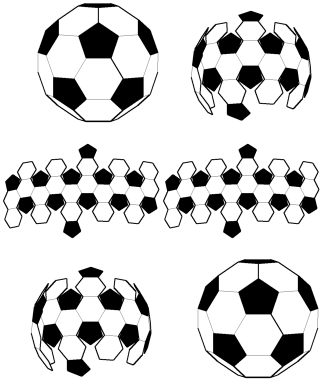
Curvature is a mathematical way of describing how much a surface "bends", or "curves" at each point. For example, a flat sheet of paper doesn't bend around any of its points and it therefore has zero curvature, but a round ball is positively curved at each point.
Differential geometry uses calculus to derive different kinds of curvature for smooth surfaces, but curvature of polyhedral surfaces can be dealt with in a much more elementary way.
The discrete Gauss curvature measures the bending of a polyhedral surface at each of its vertices. At each vertex we consider the angles formed on the adjacent faces at that corner. If the sum of these angles is exactly 3600 then the collection of faces can be flattened to the plane without a gap and without any overlap.
Therefore, it has zero curvature. If the sum of the angles is smaller than 3600 then the situation is like at the tip of a cone, or at the corner of a convex polyhedron. Here the curvature should be positive since such a polyhedron is similar to a round ball. Negative curvature arises if the sum of the angles is bigger than 3600 which happens, for example, at a saddle point.
In general, the discrete Gauss curvature at a vertex is defined as the difference of 3600 and the sum of the angles between adjacent faces adjoining the vertex:
K(vertex) = 3600 - a1 - a2 - a3 -...- an,
where n is the number of faces adjoining the vertex, and a1,...,an are the angles on the faces.
Comment
-
im feeling harmonica boyThey said God has a Tim Tebow complex!
Brew Crew in 2011!!!Comment
-
It's too late...we're fucked.Comment
-
as in robert and jimmy?Originally posted by PlantPage55They said God has a Tim Tebow complex!
Brew Crew in 2011!!!Comment
-
Originally posted by MOBB DEEP
Dick and Peter JohnsonComment
-
Yes, Robert and Jimmy. "PlantJonesBonhamPage" didn't roll off the tongue as well.
Comment
-
The rhythm section gets overlooked again.Originally posted by PlantPage55When the going gets weird, the weird turn pro ~Hunter S.Comment
-

I DON"T KNOW WHAT WE ARE TALKING ABOUT!Comment
-
Someone has to say it?
WHAT THE FUCK IS THIS THREAD ABOUT AGAIN? Ok I'm cool now. Sorry.Snake's Twitter comments would be LEGENDARY.........if I was ugly or gave a shit about Twitter.Comment
-
Originally posted by SnakeLH2006
its about that....They said God has a Tim Tebow complex!
Brew Crew in 2011!!!Comment
-
 sigpic
Comment
-
"You're all very smart, and I'm very dumb." - PartialComment

 Tweet
Tweet


Comment