Announcement

Collapse
No announcement yet.

OFFICIAL PACKERS LEGENDS THREAD

Collapse
X
 
  • Filter
  • Time
  • Show
Clear All
new posts

  • #76
    This caught my eye about Calhoun: "As a newspaper reporter and team secretary..."

    My, how times have changed. I know that was a kind of conflict of interest, but I used to enjoy the more descriptive, less antagonistic renderings of the game stories. You know, the old "Two storied teams took to the field Sunday against the autumn gold background of Lambeau Field" and all that.
    "The Devine era is actually worse than you remember if you go back and look at it."

    KYPack

    Comment


    • #77
      Originally posted by Fritz
      This caught my eye about Calhoun: "As a newspaper reporter and team secretary..."

      My, how times have changed. I know that was a kind of conflict of interest, but I used to enjoy the more descriptive, less antagonistic renderings of the game stories. You know, the old "Two storied teams took to the field Sunday against the autumn gold background of Lambeau Field" and all that.
      I couldn't agree more.

      Comment


      • #78
        Originally posted by Fritz
        This caught my eye about Calhoun: "As a newspaper reporter and team secretary..."

        My, how times have changed. I know that was a kind of conflict of interest, but I used to enjoy the more descriptive, less antagonistic renderings of the game stories. You know, the old "Two storied teams took to the field Sunday against the autumn gold background of Lambeau Field" and all that.
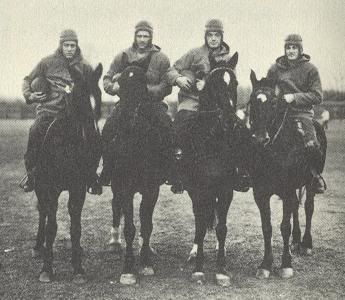
        "Outlined against a blue-gray October sky, the Four Horsemen rode again. In dramatic lore they are known as Famine, Pestilence, Destruction and Death. These are only aliases. Their real names are Stuhldreher, Miller, Crowley and Layden. They formed the crest of the South Bend cyclone before which another fighting Army football team was swept over the precipice at the Polo Grounds yesterday afternoon as 55,000 spectators peered down on the bewildering panorama spread on the green plain below.

        A cyclone can’t be snared. It may be surrounded, but somewhere it breaks through to keep on going. When the cyclone starts from South Bend, where the candle lights still gleam through the Indiana sycamores, those in the way must take to storm cellars at top speed." -Grantland Rice

        You mean like that?
        "Greatness is not an act... but a habit.Greatness is not an act... but a habit." -Greg Jennings

        Comment


        • #79
          Originally posted by MJZiggy
          Originally posted by Fritz
          This caught my eye about Calhoun: "As a newspaper reporter and team secretary..."

          My, how times have changed. I know that was a kind of conflict of interest, but I used to enjoy the more descriptive, less antagonistic renderings of the game stories. You know, the old "Two storied teams took to the field Sunday against the autumn gold background of Lambeau Field" and all that.
          "Outlined against a blue-gray October sky, the Four Horsemen rode again. In dramatic lore they are known as Famine, Pestilence, Destruction and Death. These are only aliases. Their real names are Stuhldreher, Miller, Crowley and Layden. They formed the crest of the South Bend cyclone before which another fighting Army football team was swept over the precipice at the Polo Grounds yesterday afternoon as 55,000 spectators peered down on the bewildering panorama spread on the green plain below.

          A cyclone can’t be snared. It may be surrounded, but somewhere it breaks through to keep on going. When the cyclone starts from South Bend, where the candle lights still gleam through the Indiana sycamores, those in the way must take to storm cellars at top speed." -Grantland Rice

          You mean like that?
          And that brings up another Packer legend. Jim Crowley, the horseman on the left, Green Bay East Hish School graduate and Green Bay Packer in 1925.

          He only played three professional football games before going into coaching at the college level.

          Comment


          • #80
            Originally posted by vince
            Originally posted by MJZiggy
            Originally posted by Fritz
            This caught my eye about Calhoun: "As a newspaper reporter and team secretary..."

            My, how times have changed. I know that was a kind of conflict of interest, but I used to enjoy the more descriptive, less antagonistic renderings of the game stories. You know, the old "Two storied teams took to the field Sunday against the autumn gold background of Lambeau Field" and all that.
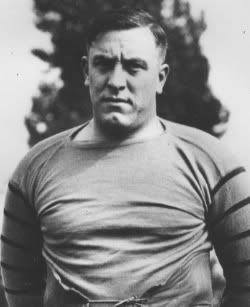
            "Outlined against a blue-gray October sky, the Four Horsemen rode again. In dramatic lore they are known as Famine, Pestilence, Destruction and Death. These are only aliases. Their real names are Stuhldreher, Miller, Crowley and Layden. They formed the crest of the South Bend cyclone before which another fighting Army football team was swept over the precipice at the Polo Grounds yesterday afternoon as 55,000 spectators peered down on the bewildering panorama spread on the green plain below.

            A cyclone can’t be snared. It may be surrounded, but somewhere it breaks through to keep on going. When the cyclone starts from South Bend, where the candle lights still gleam through the Indiana sycamores, those in the way must take to storm cellars at top speed." -Grantland Rice

            You mean like that?
            And that brings up another Packer legend. Jim Crowley, the horseman on the left, Green Bay East Hish School graduate and Green Bay Packer in 1925.


            He only played three professional football games before going into coaching at the college level.

            Coincidently, Crowley played high school football in Green Bay and was coach by Curly. Crowley later went on to coach college football at Fordham and coached Vince Lombardi.
            After lunch the players lounged about the hotel patio watching the surf fling white plumes high against the darkening sky. Clouds were piling up in the west… Vince Lombardi frowned.

            Comment


            • #81
              Not a Packer....but a Green Bay legend, writer, Red Smith:


              “After lunch the players lounged about the hotel patio watching the surf fling white plumes high against the darkening sky. Clouds were piling up in the west… Vince Lombardi frowned.”
              After lunch the players lounged about the hotel patio watching the surf fling white plumes high against the darkening sky. Clouds were piling up in the west… Vince Lombardi frowned.

              Comment


              • #82
                Originally posted by HowardRoark
                Not a Packer....but a Green Bay legend, writer, Red Smith:


                “After lunch the players lounged about the hotel patio watching the surf fling white plumes high against the darkening sky. Clouds were piling up in the west… Vince Lombardi frowned.”
                And now I'm sitting here listening to Gruden. Ugh.
                "Greatness is not an act... but a habit.Greatness is not an act... but a habit." -Greg Jennings

                Comment


                • #83
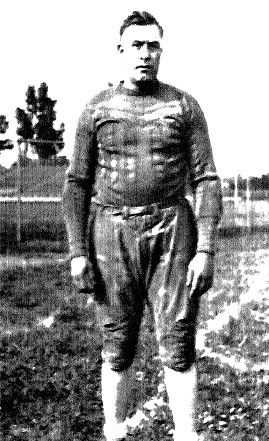
                  Jug Earp


                  Jug Earp was an anchor in the Packer offensive and defensive lines for 11 seasons.

                  The 6’1”, 235-pound Monmouth College standout was a center and tackle as a Packer from 1922-’32.

                  Along with Cal Hubbard, he is considered the best defensive tackle of the Lambeau era.

                  Earp played valiantly with such injuries as broken ribs and an arm wrenched so badly he couldn’t lift it up to his chest.

                  After his playing career, Earp served as the first president of the Packer Alumni Organization.

                  From 1950 through ‘54, he was Packer publicity director.

                  Earp’s nickname, “Jug,” is derived from his college nickname, “Juggernaut.”

                  Comment


                  • #84
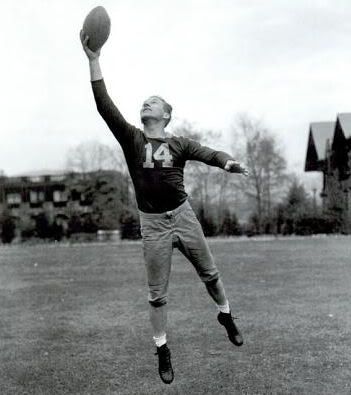
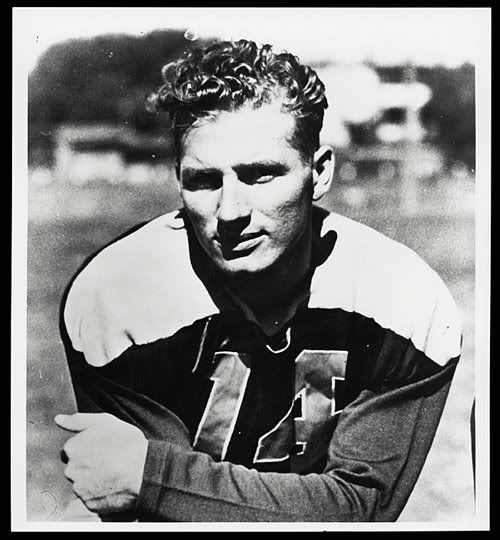
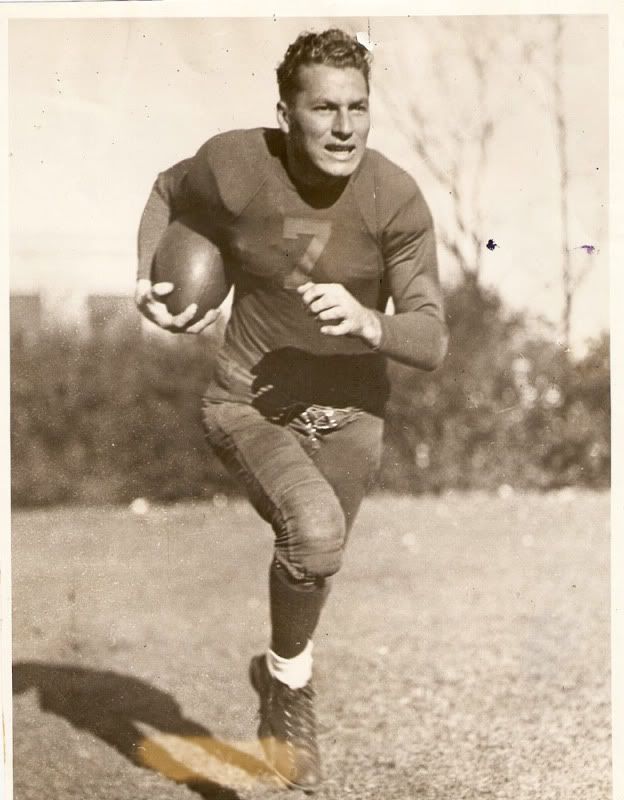
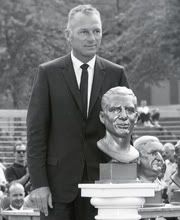
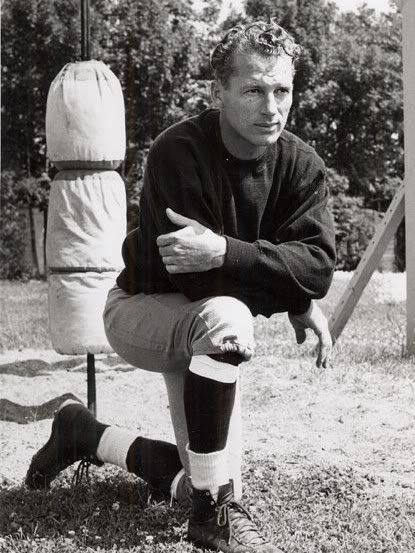
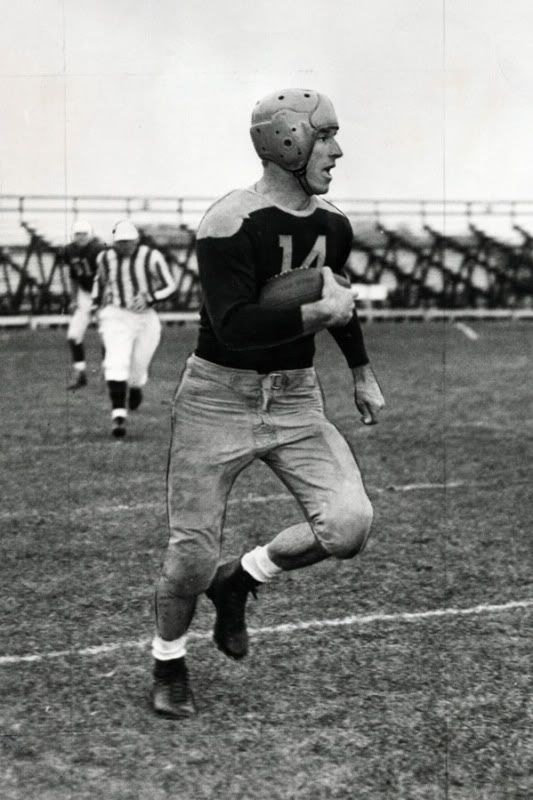
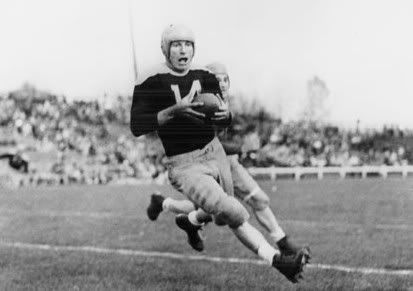
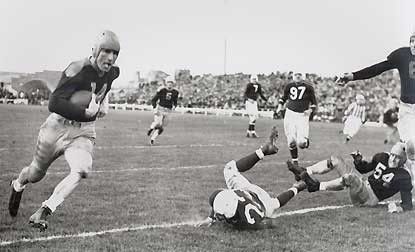
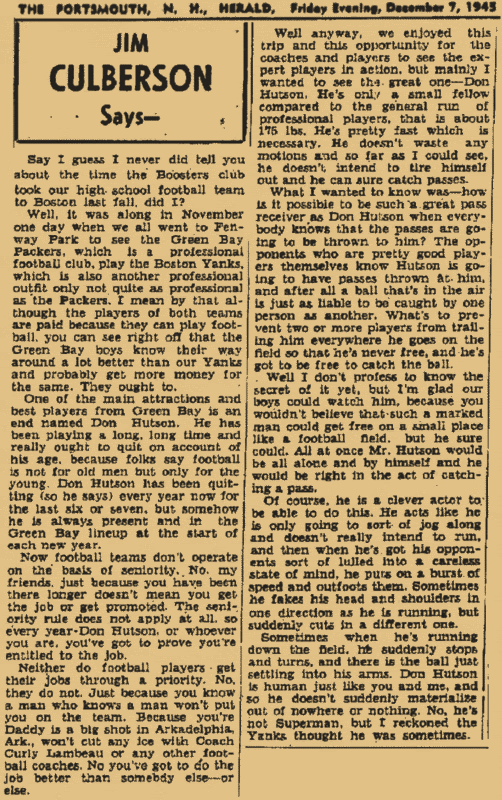
                    Don Hutson


                    Before there was Jerry Rice, before there was Steve Largent, before there were even pass patterns, there was Don Hutson.

                    He was a receiver ahead of his time by a half-century. That's how long it took for the National Football League to catch up with the "Alabama Antelope."

                    With his great speed, great moves, and great hands, Hutson was an exceptionally dangerous receiver.

                    Hutson didn't merely catch more passes and score more touchdowns than anybody imagined possible. He changed the way football was played.

                    Few teams threw the ball in 1935 unless they were desperate or wanted to surprise the opponent. Hutson was football's Copernicus, proving that the universe did not revolve around the run.

                    By the time he retired in 1945, passing was a significant part of the game. As for the receiving part, nobody played the game like Hutson.

                    The Definition of “Dominant"

                    There's hardly a word to describe his accomplishments. "Dominant" is diminished through overuse, but if it ever applied to a player it would be Hutson.

                    When he retired, his deeds occupied a full page in the N.F.L. record book. He owned every receiving mark that existed by a wide margin.

                    He led the NFL in touchdowns a-record-likely-never-to-be-broken eight times. More than 50 years later, no other player in history else has led the league more than three.

                    He also led the league in catches a record eight times, including 1942, when he had a then-astonishing 74 receptions. His nearest rival caught 27 passes that season.

                    In nine seasons he was the top touchdown receiver in the league (Rice is second all-time with six).

                    Amazingly, not only is Hutson listed first for most consecutive years (five) leading the NFL in touchdown catches, he also has the second most with four.

                    Hutson finished his career with 99 touchdown receptions, an astounding 62 TDs ahead of his closest competitor.

                    Steve Largent finally broke Hutson's record 44 years later. Largent, Rice and other modern-day receivers simply traced the footsteps that Hutson blazed.

                    Hutson caught 74 passes for 1,211 yards and 17 touchdowns while playing 11 games in 1942.


                    For his career, Hutson averaged .85 touchdowns per game. Rice averaged .65 touchdowns per game.

                    He finished with the most receiving yards seven times, including four in row. He led the league in touchdown receptions nine times, including five in a row. No player has matched those records.

                    Hutson retired with 488 receptions and 7,991 yards. The second-place receiver had 190 catches and 3,309 yards.

                    Hutson played in an era of 10- to 12-game seasons, so his records might have stood forever if he had the 16-game opportunities enjoyed today.


                    Perhaps Hutson's greatest performance came on Oct. 7, 1945. He caught four touchdown passes and kicked five extra points -- in one quarter. The 29-point quarter is a record that may never be broken.

                    Twenty percent of all his receptions were touchdowns. He scored a total of 105 touchdowns in just 117 games.

                    The Packers won three NFL championships (1936, `39 and '44). He retired with 19 NFL records, was named to the all-pro team in 8 of his 11 seasons and was NFL MVP in 1941 and '42.

                    Hutson was such a dominant player that you can't just compare him to other players of his era—his stats compare favorably to those of entire teams.


                    In 1942 (in which he earned his second consecutive MVP), Hutson made more receptions than three entire teams: the Detroit Lions, the New York Giants and Philadelphia Eagles.

                    In that same season, he scored 17 touchdowns, as many as the Pittsburgh Steelers and more than the Eagles, Brooklyn Dodgers, Chicago Cardinals and Detroit Lions. More, even, than the Cardinals and Lions combined.

                    The Man. The Legend of Legends.

                    Hutson was born on Jan. 31, 1913, in Pine Bluff, Ark. As a Boy Scout he played with snakes. He said that's where he got his quickness and agility.


                    At the University of Alabama, Hutson was named to all-America teams in 1933 and 1934, his junior and senior seasons.

                    In 11 seasons (1935-45) with the Packers, he played end (as wide receivers were known then) on offense and safety on defense. He was also the kicker.

                    Three times -- in 1936, 1939 and 1944 -- his Packer teams won NFL championships.

                    In 9 of his 11 seasons, Hutson was voted to the National Football League's All-Pro team, and twice he was named the league's most valuable player.


                    Hutson was a charter member of both the College Football Hall of Fame (1951) and the Pro Football Hall of Fame (1963).

                    Opposing coach, Greasy Neale of the Philadelphia Eagles, said, ''Hutson is the only man I ever saw who could feint in three different directions at the same time.''

                    Another coach, Luke Johnsos of the Chicago Bears, said it was difficult to defend against Hutson because ''half the time, he didn't know himself where he was going.''

                    At 6 feet 1 inch and 185 pounds, Hutson was willowy, and he looked even more sleek because he wore tiny shoulder pads and no hip pads. He could run 100 yards in 9.7 seconds.


                    ''For every pass I caught in a game,'' he once said, ''I caught a thousand passes in practice.''

                    Hutson played football only one year in high school and was better known then for his collection of pet rattlesnakes.

                    He got to Alabama only because Bob Seawall, a high school teammate, said he would go there only if Alabama would take Hutson, too.

                    Seawall dropped out of Alabama after two years. Hutson stayed and became more celebrated than the other starting end, Paul (Bear) Bryant, his partner in a campus dry-cleaning business, who went on to become one of college football's legendary coaches.

                    "Don had the most fluid motion you had ever seen when he was running," said the Bear. "It looked like he was going just as fast as possible when all of a sudden he would put on an extra burst of speed and be gone."


                    ''Hutson would glide downfield, leaning forward,'' Lambeau said, ''as if to steady himself close to the ground. Then, as suddenly as you gulp or blink an eye, he'd feint one way and go the other, reach up like a dancer, gracefully squeeze the ball and leave the scene of the accident, the accident being the defensive backs who tangled their feet up and fell trying to cover him.''

                    At a time when most N.F.L. starters were paid $100 a game, he signed with the Packers for $175 a game.

                    On the first play of his first pro game, the legend began. The Packers were playing the Chicago Bears in Green Bay. On the first play, instead of the expected run, the Packers called a pass. The Bears' defense concentrated on Johnny (Blood) McNally, the Packers' dangerous running back and receiver. On the other side of the field, Hutson loped lazily downfield, with only Beattie Feathers covering him.

                    Hutson stole a look at McNally. So did Feathers, a mistake because as soon as Feathers was distracted, Hutson took off. Arnie Herber's pass hit Hutson in stride, and he outran Feathers for an 83-yard touchdown.

                    ''For the next 10 years,'' said George Halas, the Bears' coach, ''Hutson was doing that sort of thing to every club in the National Football League. I just concede him two touchdowns a game, and I hope we can score more.''


                    Other coaches agreed.

                    ''He was a cold, hard competitor,'' said Jimmy Conzelman, the former Chicago Cardinals coach. ''I doubt that he had a nerve in his body.''

                    When Hutson retired in 1945, he was earning $15,000 a year, a huge salary then. His skills were still there, but, he said, ''It was playing defense that wore me out.''

                    He spent two years as an assistant coach of the Packers. Then, living in Green Bay and active in civic affairs, he became wealthy as the owner of an auto dealership and bowling lanes in Racine, Wis.

                    ''He most certainly was the greatest player in the history of this franchise,'' the Packers' general manager, Ron Wolf, said.

                    He also was a quiet, unflappable man.

                    ''The day we were married,'' said his wife, Julia, ''he was so calm that you'd think he'd merely stepped into the church to get out of the rain.''

                    His mother added: ''He wouldn't say two words in an A-bomb attack. He doesn't talk unless he has something to say.''


                    "Different era, different time, but the numbers he put up in a time when they didn't throw as many passes were unbelievable," said former Packer coach Mike Holmgren. "He was better than everybody he was playing against, clearly."

                    The only reason he was in Green Bay was because most of the other coaches in the league thought he was too fragile.

                    Defenses began double and triple-teaming him, concepts that were unheard of at the time.

                    "He had all the moves," said teammate Tony Canadeo. "He invented the moves. And he had great hands and speed, deceptive speed. He could go get the long ones; run the hitch, the down-and-out. He'd go over the middle, too, and he was great at getting off the line because he always had people popping him."

                    Following his retirement as a player, Hutson was an assistant coach for the Packers under Lambeau for three seasons (1946-48).

                    He served on the club's board of directors from1952-80, when he was elected a director emeritus.

                    When the Packers built their indoor practice facility in 1994, they needed a name. Despite the many great names that played for the storied franchise, there was never any doubt which athlete the place would honor. It was christened the Don Hutson Center.

                    "I don't know if there is such a thing as royalty in professional football," said Packers general manager Ron Wolf as he stood next to Hutson at the dedication ceremony, "but this is the closest I've ever come to it."

                    Although he had been an All-America at Alabama in 1934, there were plenty who doubted the skinny speedster could stand the pace of pro football. But it wasn't long before his mere presence on the field had changed the defensive concept of the game.

                    Like everyone in the days before free substitution, Hutson was a 60-minute player who spent most of his career as a very fine safety on defense.

                    In his final six seasons, he swiped 30 opposing quarterbacks’ passes. Often after scoring a touchdown, he would kick the extra point.

                    Curly Lambeau had the vision to bring the passing game into pro football, but it was Don Hutson who made it work.

                    There will never be another player to single-handedly redefine the game like Don Hutson.

                    Comment


                    • #85
                      http://www.coldhardfootballfacts.com/Articles/11_402_You_take_Rice,_we'll_take_Hutson.html

                      You take Rice, we'll take Hutson
                      Cold, Hard Football Facts for September 6, 2005

                      (Ed. Note: This piece originally ran September 6, 2005. Naturally, it pissed off those modern fans who believe John Elway invented football at Stanford in 1982.)

                      By Cold, Hard Football Facts contributor Mike Carlson

                      In a rare moment of sobriety, we remember the walls of our cardboard chalet echoing as the lid was slammed shut on the proposition that Jerry Rice was the greatest football player of all time.

                      And when we use Jim Brown to slam shut a lid, that LID STAYS SLAMMED SHUT. Even if we would like to make a case for Bobby Bell as Brown's defensive equivalent, that case might well be as fizzy as a 12-pack of Old Milwaukee and more anecdotal than my grandfather after a 98 (that's seven 7&7s). And in a future column, we may revive the old Bill Russell vs Wilt Chamberlain debate by reminding readers of the legacy of another Cleveland Brown, Otto Graham, the greatest winning quarterback in NFL history.

                      But for now, there are a couple of points to make about Rice, who retired yesterday after a brilliant, record-shattering 20-year NFL career. When baseball guru Bill James produced all-time rankings of players, he made two separate lists, one for "peak value" and the other for "career value." Certainly Rice's career value is unparalleled. Like a gridiron equivalent of Hank Aaron or Eddie Collins, he turned in top-flight seasons in three different decades – including a mini-revival in Oakland – and his ability to deliver first downs and touchdowns remained impressive. He played 20 seasons, and really only two of them were duds (one of those due to injury). Longevity, in this instance, is a strong indicator of quality, in and of itself.

                      So surely, if Rice's career value is so high but he's not the greatest player of all time, he's got to be the greatest receiver of all time, right?

                      Wrong. Much as we'd like to agree, the Cold, Hard Football Facts suggest otherwise. There's a very good argument to be made for the guy who could be said to have invented the pass pattern: Don Hutson, who tore up defenses for Green Bay from 1935 to 1945. If greatness is reflected in dominance, no receiver was greater because no receiver ever dominated his game the way Hutson did.


                      Catches
                      Rice has more catches (1,549) than anyone in NFL history, obviously. But no one has ever led the league in receiving eight times – except Hutson. Eight times in 11 seasons. Runner-up Lionel Taylor of Denver led the AFL five times in the earliest days of the upstart league’s existence. Rice led the league in receptions twice (1990, 1996). Hutson led the NFL five years in a row (1941-45)! No one else, not even Rice, has come close. Among NFL receivers, just three (Tom Fears of the L.A. Rams, Pete Pihos of Philadelphia and Raymond Berry of Baltimore) boast three consecutive years leading the league in receptions. Taylor topped the AFL receiving list its first four years (1960-63), putting him alone at second on this elite list of reception leaders. Hutson retired with 488 receptions, more than doubling the previous record of 190 catches.

                      Receiving yards
                      What about yards, you say? Rice led the league in receiving yardage six times in his 20 seasons. Impressive, for sure. But Hutson led the league seven times, including a record four years in a row (1941-44). Hutson doesn't figure in the yardage-per-season figures, but he does have four games with over 200 yards, second in NFL history only to Lance Alworth's five. (Rice and Charley Hennigan, who played for Houston of the AFL, also have four 200-yard games on their resume). Hutson, in other words, was a big-play receiver. In the first play from scrimmage of his first NFL start (his second game) Hutson caught an 83-yard touchdown pass from Arnie Herber, which led the Packers to a 7-0 win over Chicago.

                      Touchdowns
                      Rice led the league in touchdown catches six times in 20 seasons, but Hutson led the league nine times in 11. He retired in 1945 with 99 touchdown catches, which was the record until Steve Largent passed it a full 44 seasons later. Sixty years after Hutson last played, back in the Stone Age of NFL offense, he remains fifth on the all-time touchdown reception list. He led the NFL in scores every year between 1935 and 1938, skipped 1939, and then every year from 1940 through 1944. His 17 TD receptions in the 11-game 1942 season has been eclipsed by guys playing longer seasons, including Rice's record 22 in the 16-game 1987 season, but remains the Packers team record.

                      Championships
                      Rice was a premier postseason performer, and he won three championships in his career with San Francisco before ending up on the losing end of Super Bowl XXXVII, when he wore an Oakland uniform. Hutson also went 3-1 in NFL title games, winning championships for TitleTown in 1936 (beating the Boston Redskins at the Polo Grounds in New York City), 1939 and 1944. The Packers lost to the Giants in the 1938 championship game.

                      Career performance
                      Hutson’s 1942 campaign was probably the greatest season by a receiver in NFL history. In 11 games, Hutson caught 74 passes for 1,211 yards (16.4 YPC) and 17 TDs – numbers that even by today’s pass-happy standards would have put Hutson in the Pro Bowl. Rice, the dominant receiver of our day, played his entire career with the benefit of a 16-game schedule. He surpassed 17 TDs just once and equaled it one other time. Projected over a 16-game schedule, Hutson would have caught 108 passes for 1,761 yards and 25 TDs in 1942.

                      The year 1942 was for receiving what Babe Ruth’s 1920 season was for home runs. Ruth hit 54 dingers that year, one season after hitting 29. Before Ruth came along, the home run record stood at 16.

                      Pros and cons
                      Hutson did it all in an era where the forward pass was still considered risky. Of course, the era argument works both for and against Hutson. You might argue that because the passing game wasn't featured, it was easier for Hutson to lead the league so often. The obvious rejoinder is that Green Bay passed so much because, in Hutson, they had a unique receiving threat.

                      In the two-way era, he also played defensive back for the Packers. He had 30 interceptions in the seven seasons those stats were kept. He was also a place kicker, though not an exceptional one by the standards of the day. But remember, he was kicking, and Hebner was throwing, a ball which was as close to a rugby ball as it is to today's aerodynamic spiraller. Just ask Bennie Friedman.


                      We don't doubt that Jerry Rice would have grabbed some picks if the NFL still played both ways. And you can argue that the NFL between 1942-44 wasn't as strong as it would have been had not coaches Eisenhower and MacArthur drafted players away for the big games against the Berlin '39ers and Tokyo Rising Suns. But from 1935-41, that argument doesn't apply.


                      Comparing eras
                      A great comparison can be made across the eras as well. In the same sense that Hutson was lucky to have joined the Packers when they were coached by Curly Lambeau – who wasn't philosophically opposed to the forward pass, like most contemporary coaches – he also had capable quarterbacks. He was thrown to by Herber and then by Cecil Isbell, both fine passers for the time, but he also had good results catching balls from Irv Comp. Rice, of course, was a perfect fit for Bill Walsh's offense, and blessed with Joe Montana and Steve Young tossing him the ball. But the 49er West Coast offense flourished without Rice. Green Bay's passing floundered in the years after Hutson.

                      In 1945, the Packers went 6-4 with Hutson catching 47 passes for 834 yards (17.9 per catch) and 9 TDs (the equivalent of 75 for 1,326 and 15 TDs in a 16-game season). The Packers offense was second in the NFL, scoring 25.8 points per game. The next season, without Hutson, the Pack managed to finish 6-5, but their offensive production was cut virtually in half, falling to just 13.4 PPG.

                      In Rice's last season in San Francisco, he caught 75 passes for 805 yards (10.5 per catch) and 7 TDs. The 49ers went 6-10. The next year, without Rice, and with no one stepping up as second receiver, they improved to 12-4 as Terrell Owens (93 for 1,412 and 16 TDs) filled both the No. 1 and No. 2 receiving slots.

                      We don't doubt that Hutson could have competed well into the succeeding decades, even at his 1930s-40s stature: 6-foot-1-inch, 183 pounds. In that sense the receiver he most resembles is a Raymond Berry, but who was also an exceptional deep threat. As much as anything, Hutson was an athlete; he went to Alabama on a baseball scholarship, and was a football walk-on.

                      The "Alabama Antelope" never made All-America for the Tide. It wasn't until he got into an aerial context that his real skills showed. He was the pioneer: the first guy with the curved stick, the first one shooting the jump shot. No one else in his 11 years was even close to him as a receiver. Jerry Rice was very good for longer than anyone in football history. He was great for a similar time as Hutson, perhaps longer (of course, Hutson had to make a living after football, which was a great career-shortener). But Rice was less dominant at his peak and wasn't the trailblazer the Hutson was. All of which suggests that Rice may rank No. 2 on the all-time list.

                      Comment


                      • #86
                        Video: Don Hutson - All-Time Team

                        Comment


                        • #87
                          Nice.

                          Not sure how old you are Vince, but was there pressure for a guy like Hutson to go fight in WW II? Didn’t most of the able bodied men go fight during those years?
                          After lunch the players lounged about the hotel patio watching the surf fling white plumes high against the darkening sky. Clouds were piling up in the west… Vince Lombardi frowned.

                          Comment


                          • #88
                            Not sure if this has already been mentioned, but Hutson almost did not become a Packer:

                            Had it not been for a unique decision by NFL President Joe Carr, Hutson might never have become a landmark pass-catcher. After college, Don signed contracts with both the pass-minded Packers and the NFL’s Brooklyn Dodgers, a team that rarely passed. Carr ruled the contract with the earliest postmark would be honored. The Packers' contract was postmarked 8:30 a.m., 17 minutes earlier than the Dodgers' pact. Thus Hutson became a Packer.
                            I can't run no more
                            With that lawless crowd
                            While the killers in high places
                            Say their prayers out loud
                            But they've summoned, they've summoned up
                            A thundercloud
                            They're going to hear from me - Leonard Cohen

                            Comment


                            • #89
                              Good question Howard. I know a lot of players took years off to fight, Canadeo being the most notable Packer. I think it was voluntary. Different times.

                              Comment


                              • #90
                                Here's an account of one of those old sportswriters, a little light on the romanticism but a good read, about the "great one" - Don Hutson.

                                Comment

                                Working...
                                X