
 Tweet
Tweet
Originally posted by Fritz
The paper's really interesting and is full of lots of data and compelling graphs like:
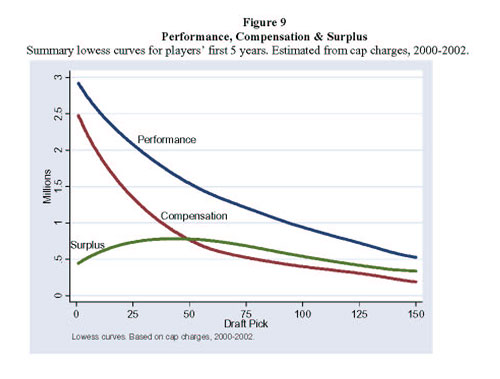
The important thing to look at on that graph is the "surplus" line, which is the difference between the curves, that is performance value minus compensation cost. The operative principle is that compensation falls off faster towards the end of the first round than does performance, so the maximum surplus falls between picks 25 and 75, and the surplus for third round players is actually greater than much of the first round.
That's not to say, of course, that the player picked at #30 will be better than the player picked at #1, simply that the player picked at #30 and some combination of other players who can be signed with the money you didn't have to pay the guy picked #1 will bring more total utility for your team than the #1 guy will.
The ultimate benefit of the high picks is that they offer a higher chance at picking true superstars, who are richly compensated and more than merit it with their performance (and you definitely want those guys), but based on the numbers and the probabilities, late firsts, as well as seconds and thirds are really the picks you want if you're going to stockpile.
You can absolutely win championships with a combination of late firsts, second and third round guys, and reasonably priced free agents. In fact, that's how most teams win championships these days.


Comment