
 Tweet
Tweet
Originally posted by pbmax
-
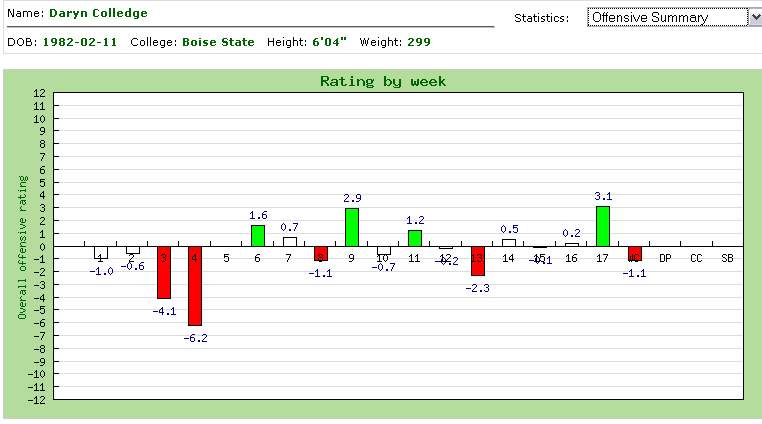
This would seem to support the conclusion that if you take away his three-week adventure at LT, Colledge had a pretty ordinary, ok season. The only surprise I see are the two putrid ratings in run blocking at home against MN and BAL. I suppose those couple of bad games are no big deal and will come out in the wash as long as Colledge isn't also responsible for getting his QB killed. -
The data above seems to indicate Barbre was the weakest link overall (IMO). Colledge has shown himself to be a solid contributor week to week, but never a standout. Quite often not standing out on the OL is a good thing!All tyrannies rule through fraud and force, but once the fraud is exposed they must rely exclusively on force.
George OrwellComment
-
I take it that no one can have a positive penalty rating..."Never, never ever support a punk like mraynrand. Rather be as I am and feel real sympathy for his sickness." - WoodbuckComment
-
Yes.Originally posted by mraynrand
But reading this: http://profootballfocus.com/about.php# ZERO (0.0) IS THE AVERAGE GRADE
If a player does something you would normally expect then this scores 0. If a LB makes an unblocked tackle 5 yards down the field or a linemen holds back a rusher for 4+ seconds. This is scored as 0. Grades are given as things which reasonably considered better or worse than average.
makes me trust the numbers less. If I read this correctly, their grades change depending on the situation.
How do we Grade?
Each grade given is between +2 and -2 with 0.5 increments and an average of 0. A positive intervention in the game rates a positive grading and vice versa. Very (very) little draws a +/-2 rating. In fact the distribution of non-zero grades is like this:
+2.0 0.01%
+1.5 0.3%
+1.0 16%
+0.5 37% (unbalanced because of the way WRs and HBs are rated)
-0.5 24%
-1.0 22%
-1.5 0.5%
-2.0 0.01%
The grading takes into account many things and effectively brings "intelligence" to raw statistics. For example a raw stat might tell you a Tackle conceded a sack. However, how long did he protect the QB for before he gave it up? Additionally when did he give it up? If it was within the last two minutes on a potentially game tying drive it may be rather more important than when his team is running out the clock in a 30 point blow out.Bud Adams told me the franchise he admired the most was the Kansas City Chiefs. Then he asked for more hookers and blow.Comment
-
It sounds like you're saying that a numerical grading system should not be taking context into consideration, just evaluating end results and not looking at what happened before the end or how much the play really mattered in the context of the entire game. I think those contextual questions SHOULD matter, though it is not easy for me to say how much context should matter (Does a sack allowed at the end of a blowout count only half as much against an OL as a sack given up in a close finish? Does a sack recorded in a blowout count less for a DL than in a close game?)Originally posted by pbmaxComment
-
We'll get that contextual algorithm to you by, say, middle next week.Originally posted by hoosier
 "Never, never ever support a punk like mraynrand. Rather be as I am and feel real sympathy for his sickness." - Woodbuck
Comment
-
Well, I am not sure a contextual approach works given the limits they have. They cannot review every game, they do not see the whole field and they do not evaluate matchups, playcalling or gameplans. Its just results and a stopwatch. So to add in game situations seems like picking and choosing context.Originally posted by hoosier
And I do not think game situations performance influences the pass blocking. Do we really believe there are Left Tackles who choke on Game Winning drives in pass protection? More importantly, do we really think we have enough information to separate that out from the rest of the factors?
But most importantly, if I read this correctly, they are not tracking just context (red zone, game winning/tying drive, 2 minute offense/defense, etc.) They are giving different scores for different situations. Which will alter players scores in non comparable ways depending on the competitiveness of their teams.Bud Adams told me the franchise he admired the most was the Kansas City Chiefs. Then he asked for more hookers and blow.Comment
-
Ok, so they claim to consider context but the tools they have at their disposal to define "context" are somewhat arbitrary. I understand your scepticism now.Originally posted by pbmaxComment
-
Hutchinson rated below Colledge? Unless I missed something last year (and granted, I didn't see a lot of purple games) that makes me pretty skeptical about this system myself!Originally posted by pbmax--
Imagine for a moment a world without hypothetical situations...Comment
-
There was a lot of talk last year that Hutch was declining as the season wore on. Could well be a big reason for Peterson's less than dazzling second half of the season. http://sports.yahoo.com/nfl/players/...udRrXyiDz.uLYFI can't run no more with that lawless crowd
While the killers in high places say their prayers out loud
But they've summoned, they've summoned up a thundercloud
They're going to hear from me - Leonard CohenComment
-
I think Colledge rebounds.
I have a good feeling about our line in a year or two.
Bulaga Colledge Splitz Sitton Lang
Young strong starting five.Draft Brandin Cooks WR OSU!Comment
-
And add Rodgers, Jennings, Finley, Jones, and Nelson to that and our offense is looking good for another 5-8 years.
Need to find another back soon and maybe another Wr to replace Driver. But Grant still has another 2-3 good years so we can take our time.Draft Brandin Cooks WR OSU!Comment
-
Its much easier to spot blown pass protection (and it is potentially more costly to the team) than blown run blocking, with the possible exception of short yardage.Originally posted by Guiness
I think the typical assessment of the Packers run game is that it is below average. Then when Colledge struggles in pass blocking, people throw their hands up and say enough, he does nothing right.
But the Vikings played to Hutchinson's strength last year. They became a more and more passing dominant team as the year went on. To a degree, it hides his decline from easy detection. Is here still better than Colledge? He is if you are a passing dominant team.Bud Adams told me the franchise he admired the most was the Kansas City Chiefs. Then he asked for more hookers and blow.Comment
-
Thanks for posting those stats pb. They're far from perfect, but they're as good as anything else I've seen in terms of breaking down performance on a somewhat objective play-by-play basis.
It's a little bit surprising to see Colledge in the top 20 of the guards listed, but when you look at his actual ratings, they tend to support what has been said by many. He had a negative rating in 10 of his 16 games last year, and his pass protection was clearly worse than his run blocking.
Given that the Packers' offense lives or dies on its passing game, he has left himself a lot of room for improvement in important areas.Comment
-
I think the OL is probably one of the most difficult positions for the "casual fan" to monitor and evaluate. Its easier to develop misconceptions.Busting drunk drivers in Antarctica since 2006Comment

Comment